Against the backdrop of increasingly severe global water resource conditions and rising drinking water safety standards, traditional filter media are gradually revealing performance limitations when facing unconventional application scenarios such as extreme conditions, high-temperature sterilization, and long-term service. In this context, sintered metal filter elements, by virtue of their exceptional mechanical strength, precise pore gradient design, and superior properties like high-temperature and corrosion resistance, are progressively replacing traditional filter media to become an indispensable component in modern drinking water treatment systems.
Drinking Water Filtration Process & The Key Role of Sintered Metal Filter Elements
The World Health Organization (WHO) and industry standards set strict indicators for high-quality drinking water, mainly covering the following aspects:
To achieve the above standards, modern drinking water treatment typically employs a multi-stage series deep purification process. Although membrane separation technologies (like Ultrafiltration (UF), Reverse Osmosis (RO), Nanofiltration (NF)) have become mainstream for deep purification removing dissolved salts and microorganisms, sintered metal filtration technology, with its irreplaceable physical strength and tolerance, serves as a “rigid line of defense” ensuring the safe operation of membrane systems under extreme conditions, making it an essential part of modern processes.
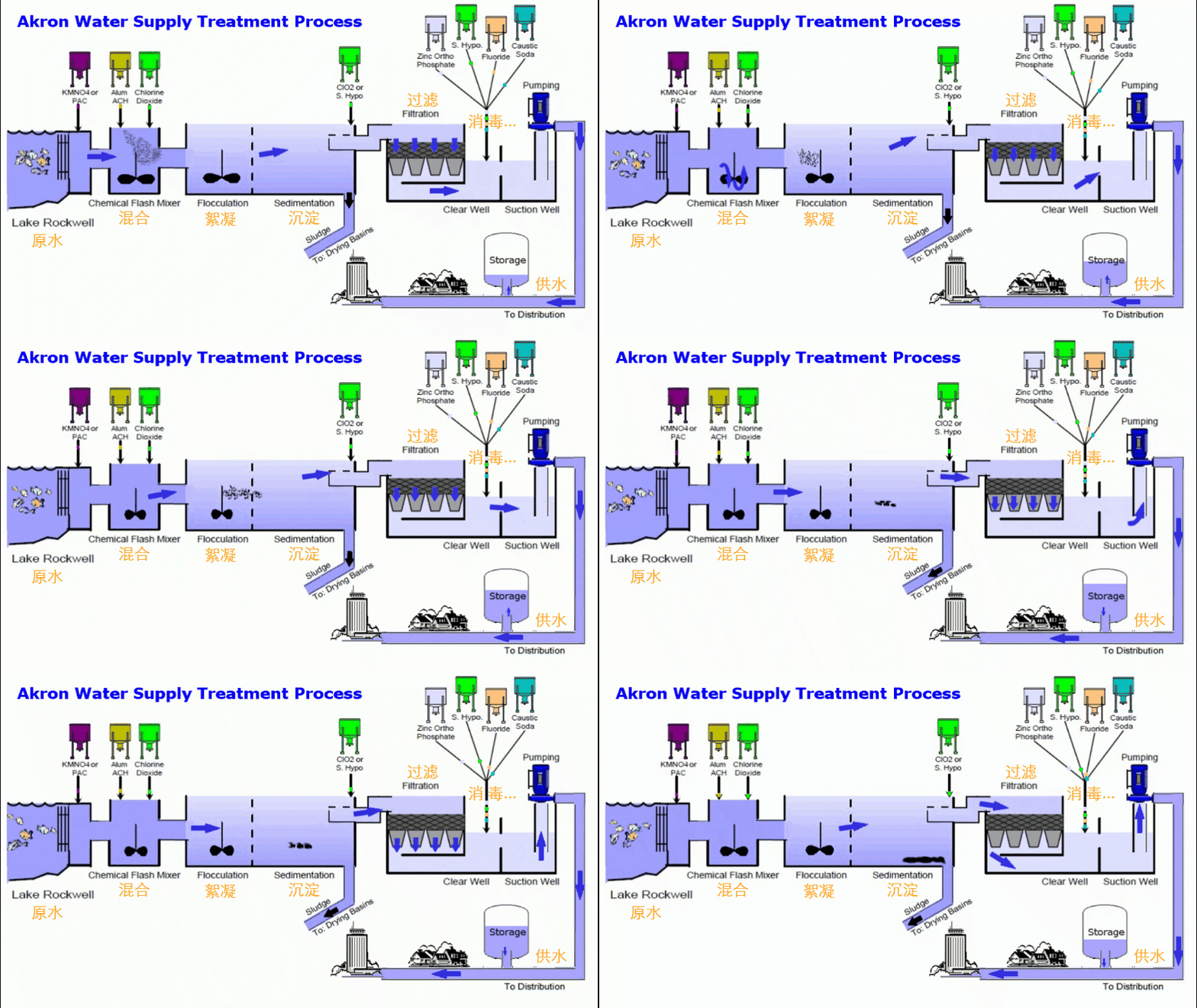
(Schematic Diagram of Water Treatment Process – Source: Internet)
▶ Main Process Stages
In this process, the filtration system must not only remove impurities but also possess the capability to withstand harsh environments, ensuring the long-term stability of the entire water supply system.
Difficulties and Challenges in Drinking Water Filtration
Although existing processes are relatively mature, practical applications still face multiple challenges related to material performance and cost-effectiveness:
✗ Limitations of Removal Mechanisms: Simple physical sieving cannot remove dissolved pollutants like heavy metals and pesticide residues. Traditional filter media struggle to be efficiently combined with adsorption materials (e.g., activated carbon, KDF), and are prone to deformation or “unloading” under high differential pressure, potentially damaging downstream precision membrane elements.
✗ Risk of Microbial Growth: Drinking water systems are rich in nutrients. Conventional filter media, after trapping organic matter, easily become breeding grounds for microorganisms, forming biofilms. This not only causes clogging but also leads to secondary contamination, and conventional cleaning struggles to thoroughly remove sludge deep within the pores.
✗ Conflict between Material Weatherability and Cost-Effectiveness: Polymer filter elements cannot withstand high-temperature (>80°C) steam sterilization or strong acid/alkali Clean-in-Place (CIP) cleaning, leading to high replacement frequency. Meanwhile, the initial manufacturing cost of high-performance filter media (e.g., some precision membranes) is high. Balancing high performance with reduced operational costs remains a key challenge for industry adoption.
Shinkai’s Drinking Water Filtration Solution
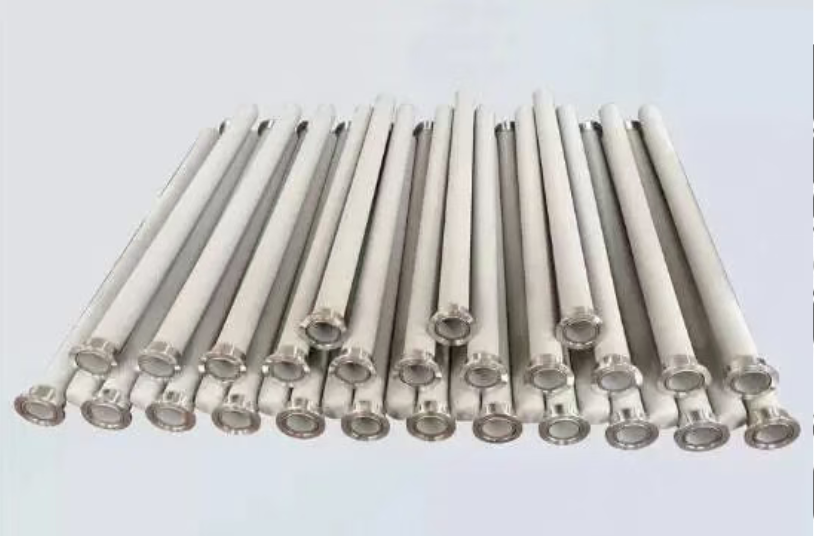
Addressing the above challenges, Shinkai’s sintered metal filter elements not only resolve the temperature and pressure tolerance pain points of traditional materials but also achieve high dirt holding capacity and long service life through their deep three-dimensional structure, providing excellent protection for high-end drinking water treatment.
▶ Pre-Membrane Precision Protection: Absolute Interception & Rigid Support
Shinkai sintered metal filter elements are specifically designed to protect expensive membrane elements like Reverse Osmosis (RO) or Nanofiltration (NF). With an absolute filtration precision of 0.1-100 μm, they completely intercept particulate debris released upstream, preventing membrane surface scratches. The robust filter structure withstands forward pressures up to 50 bar, preventing deformation or “unloading” under high differential pressure, ensuring 100% solid particle interception with zero leakage, and guaranteeing long-term safety of feed water quality.
▶ Tolerance for Extreme Conditions: High-Temperature & Corrosion Resistance
Designed for harsh environments in food, pharmaceutical, and high-end water supply systems, Shinkai filter elements demonstrate exceptional tolerance. They easily withstand temperatures up to 900°C and a wide range of acid/alkali CIP cleaning, outperforming traditional polymer filter media. Compliant with GMP standards, they can be directly used in hot water or steam sterilization lines, effectively intercepting corrosion products and welding slag, ensuring physical cleanliness of the fluid under extreme conditions.
▶ High Dirt Holding Capacity & Long Service Life: Green Cycle & Cost Reduction
Utilizing a deep 3D network structure, the dirt holding capacity of Shinkai filter elements is significantly superior to surface filtration media. Leveraging the high strength of the metal material, the elements support high-pressure backwashing, ultrasonic, and chemical soaking regeneration, with a service life of up to 10 years. This characteristic not only drastically reduces the frequency of consumable replacement and operational costs but also effectively minimizes solid waste emission, aligning perfectly with the long-term goals of green manufacturing and sustainable development.
Nanjing Shinkai is committed to providing precise and reliable core components and systems for the drinking water and high-end fluid processing sectors through high-standard specialty sintered metal filtration technology, helping your production processes achieve safer, more efficient, and greener operation. If your company faces challenges such as membrane system protection, high-temperature sterilization filtration, or high consumable costs, please feel free to contact us. Let’s explore the optimal solution together.